


|
IEEA is involved in the characterization of the influence of ionospheric scintillations on the earth satellite links. This concerns both the telecommunication and the navigation systems. The solutions offered range from simulation tools to measurements analysis. The company has provided a support to EGNOS and Galileo projects and participates to the SBAS working group of ESA / ESTEC. |
 |
Ionospheric Scintillations
Ionospheric Scintillations Studies


Monitoring in Bahir Dar
The scintillation parameters recorded by our station in Bahir Dar can be viewed here (or click on the map).
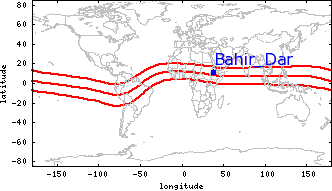
Bahir Dar is located in a region with high ionospheric scintillation activity, around the magnetic equator (the +/-20° magnetic latitude lines are also plotted on the map).
MONITOR

IEEA is prime contractor of the Monitor project launched by ESA / ESTEC in 2010. This project aims to improve our knowledge of ionospheric variability and disturbances through the development of specific GNSS receiver, the deployment of a set of receivers worldwide distributed, and the analysis of data, both TEC and scintillations. A particular attention is given to extreme scintillation events. On occurrence of such an event, the signal will continue to be recorded using a bitgrabber, activated upon exceeding a given threshold for subsequent analysis. The Monitor GNSS receivers provide hourly data files which are sent to a Central Archiving Processing Facility and processed in near real time. The outputs are generated by a number of processors developed for Monitor for some of them or in the frame of previous studies for the others.
Ionospheric Propagation Impairments for GNSS at C Band (SIPIC)
Objectives
The SIPIC ESA / ESTEC project objective was to study ionospheric propagation impairments at C band.
The ionospheric propagation errors are the most prominent errors in single frequency GNSS positioning at L-band. Therefore, the elimination of this error is an important task in operational GNSS applications.
The first-order error which may reach a few meters is proportional to the inverse of squared frequency (1/f2) and to the total electron content (TEC) measured along the ray path between GNSS satellite and receiver. Available ionospheric models can be applied for GNSS operation both at L-band as well as at C-band. The most important selection criterion for ionospheric models is their accuracy in computing slant range errors (i.e. TEC) needed for correction in operational positioning. The positioning errors due to scintillations have been studied concurrently.
PRIS Ionospheric Scintillations
Objectives
Within this ESA / ESTEC project, GPS measurements at high sampling rates (50 Hz) have been recorded in both high and low latitude regions. A data base has been constituted. These data have been used to derive the scintillation characteristics and improve scintillation models.
Additional points to this study include the analysis of data from IGS network, the generation of time series corresponding to scintillation samples in order allowing receiver testing and the development of one forecast model allowing obtaining scintillations maps.
COST actions & Space Weather activity
IEEA was involved in the last two COST actions dedicated to ionosphere studies
- COST 271: Effects of the upper Atmosphere on Terrestrial and Earth-space Communications
- COST 296: Mitigation of Ionospheric Effects on Radio Systems (MIERS)
Under the leadership of Katolik University of Leuven (KUL), IEEA participates to the SOlar TERrestrial Investigations and Archives (SOTERIA) project. SOTERIA aims at creating a wide synergy in the fields of solar-space and geo-physics among different centers in a number of European countries to achieve a higher level of quality and accessibility for the observational data and for the models. The goal is to help creating the basis for a deeper understanding of solar and space processes having terrestrial impact.
